
Lee County Superior Court
Lee County Superior Court is the county's primary trial court for broad civil and criminal jurisdiction. The Clerk of Superior Court maintains court records, files criminal and civil cases, records divorce and annulment matters, and keeps criminal warrants filed in Superior Court. The same clerk office records deeds, liens, fi fas, UCCs, military discharges, plats, trade names, and other documents that often overlap with court-record research.
Lee County sits in the Southwestern Judicial Circuit, part of Georgia's Third Judicial Administrative District. The circuit also includes Macon, Schley, Stewart, Sumter, and Webster Counties. Circuit administration is listed at the Sumter County Courthouse in Americus, with Debra Gibson as Circuit Court Administrator. Lee County's schedule is published as the fourth Monday in April and October on the county circuit page.
The federal courts shown in the image set are separate from Lee County Superior Court. The Middle District of Georgia Albany office handles federal cases from Lee County, not state Superior Court cases.
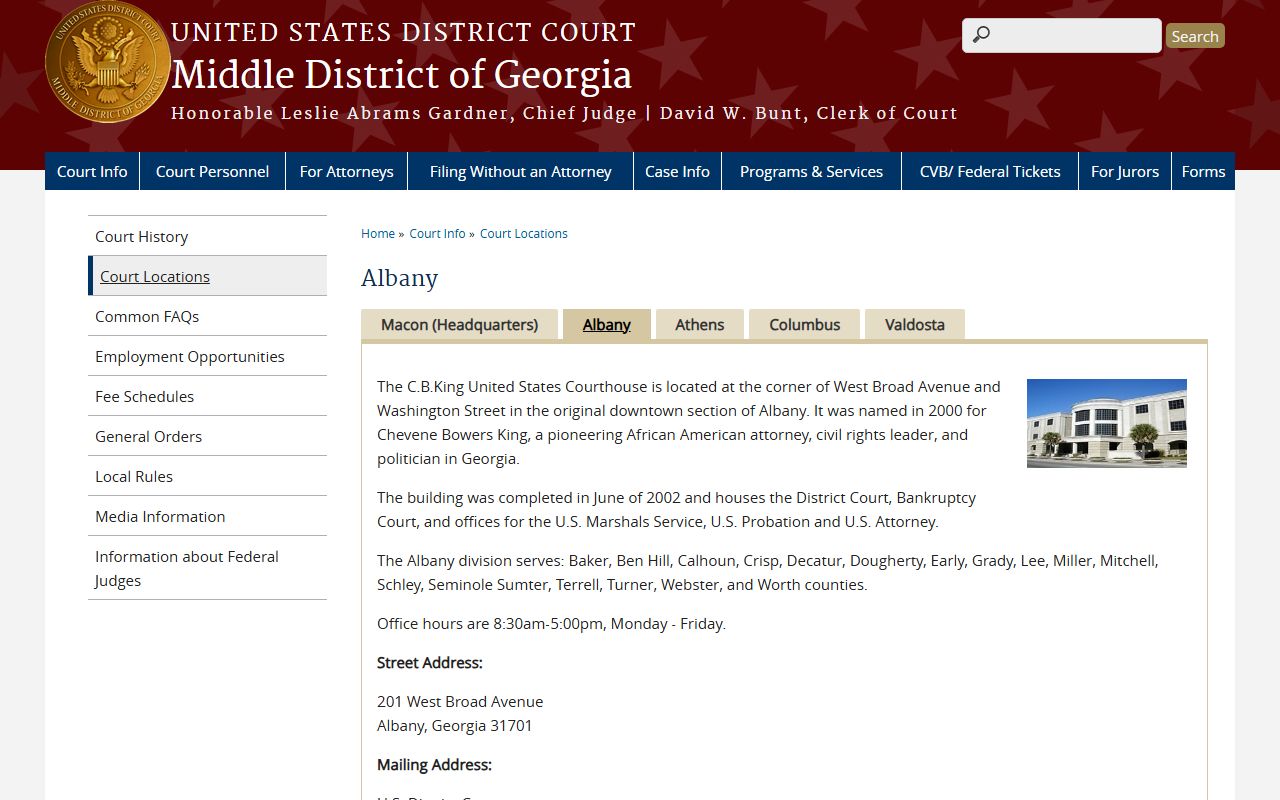
That distinction helps prevent a state-court record search from being sent to the wrong courthouse when the case is federal.
Lee County Court Offices
Lee County does not publish a list of numbered Superior Courts. The useful local table is a court and office table, because Lee County records are divided by court type and by custodian. Superior Court handles the general-jurisdiction trial file. Magistrate Court handles smaller civil matters, warrants, preliminary hearings, bond hearings, county ordinance violations, and bad checks. Probate Court handles estates, wills, guardianships, marriage, vital records, firearms licenses, and traffic fines assigned there.
| Court # | Type | Address | Phone |
|---|---|---|---|
| Superior Court | General jurisdiction civil, criminal, divorce, deeds, liens, warrants filed in Superior Court | 100 Leslie Highway, PO Box 49, Leesburg, GA 31763 | (229) 759-6018 |
| Magistrate Court | Claims up to $15,000, dispossessories, warrants, preliminary and bond hearings, ordinance matters | 104 A Leslie Highway, PO Box 530, Leesburg, GA 31763 | (229) 759-6016; (229) 759-6031 |
| Probate Court | Estates, guardianships, marriage licenses, vital records, traffic fines, firearms licenses | 100 Leslie Highway, Leesburg, GA 31763 | (229) 759-6005 |
| Southwestern Judicial Circuit | Multi-county circuit administration for Lee and five other counties | 500 West Lamar Street, PO Box 784, Americus, GA 31709 | (229) 928-4553 |
Superior vs Lower Courts
Georgia court routing in Lee County is based on subject matter. Superior Court is the court of general jurisdiction. Magistrate Court has no jury trials and is not a court of record, but it handles many first-stage civil and criminal matters. Probate Court is a court of limited but important jurisdiction for estates, marriage, vital records, and some traffic-fine functions. Municipal courts may handle city traffic or ordinance citations depending on the issuing agency.
| Superior Court | Magistrate Court | Probate Court | |
|---|---|---|---|
| Civil reach | Major civil, divorce, adoptions, name changes, habeas, garnishments, repossessions | Civil claims up to $15,000, dispossessories, garnishments, bad checks | Estate, guardianship, conservatorship, and related probate matters |
| Criminal role | Criminal case filings, Superior Court warrants, felony and serious case records | Arrest/search warrants, preliminary hearings, bond hearings, ordinance and minor criminal matters | Traffic fines where assigned; not the main criminal court |
| Records contact | Clerk of Superior Court | Magistrate Court clerk/staff and Tyler account access for civil files from 2023-present | Probate Court |
| Appeals | Forum for some lower-court appeals and trial-level filings | Civil appeals go to Superior Court | Probate appeals depend on matter type and law |
Lee County Case Flow
A Lee County Superior Court record may begin outside Superior Court. A criminal matter can start with arrest, a Magistrate Court warrant, first appearance, bond hearing, or preliminary hearing, then move to formal prosecution in Superior Court. A civil matter may start in Magistrate Court if it is within the small-claim jurisdiction, or it may start in Superior Court when the subject matter or requested relief belongs there.
Criminal flow: Arrest › Magistrate / First Appearance › Indictment or Information › Arraignment › Pretrial › Trial › Sentencing › Appeal
Civil flow: Petition Filed › Answer › Discovery › Mediation › Trial › Judgment › Appeal
Magistrate civil appeals must be filed within 30 days from judgment, while dispossessory appeals must be filed within 7 days and require payment of rent amounts determined due into the Superior Court registry.
Lee Superior Case Types
Lee County Superior Court records include criminal cases, civil suits, divorce and annulment cases, adoption files, name changes, habeas corpus petitions, suits for damages, garnishments, and repossessions. The clerk page also lists real estate transactions, property plats, fi fas, military discharges, trade names, UCCs, probation fines, child support payments, and property transfer taxes as functions handled through the office.
Some files are public in ordinary form. Others are not. Adoption records, juvenile records, sealed records, victim-identifying information, Social Security numbers, financial account numbers, medical and mental-health details, and restricted criminal-history material may be withheld or redacted. A Superior Court case search should treat an online summary as an index, not as a promise that every document can be inspected without clerk review.
Southwestern Judicial Circuit
The Southwestern Judicial Circuit includes Lee, Macon, Schley, Stewart, Sumter, and Webster Counties. The county circuit page lists court schedules for each county and gives circuit administration contact details. This circuit context matters when a Lee County Superior Court record involves a judge, prosecutor, public defender, accountability court, or circuit-level administrative contact outside the Leesburg courthouse.
The U.S. District Court for the Middle District of Georgia and U.S. Bankruptcy Court for the Middle District of Georgia are separate systems. Their Albany offices can serve Lee County residents for federal matters, but they do not keep Lee County Superior Court files.
The Bankruptcy Court Albany office is one federal source shown in the manifest for Lee County Superior Court context.
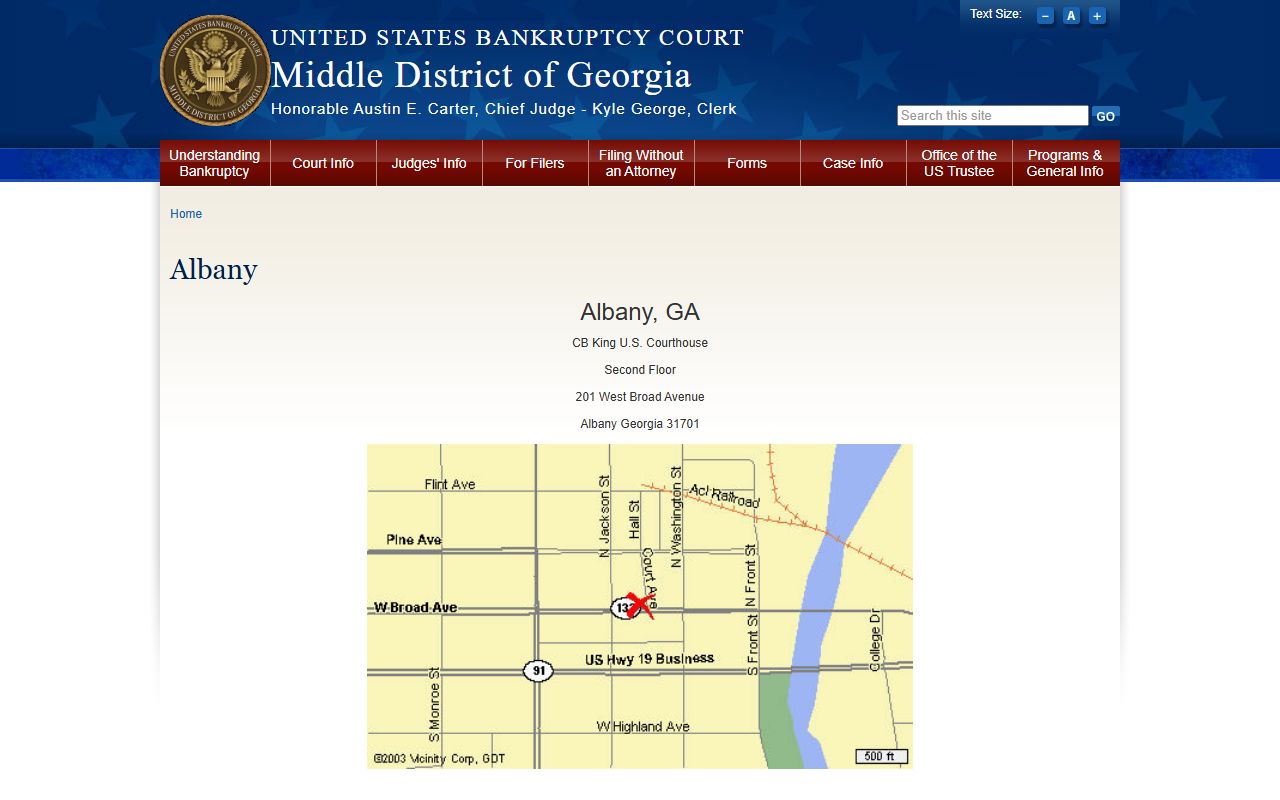
Bankruptcy records are federal records, so a bankruptcy case should be searched through the federal bankruptcy court rather than the Lee County Clerk of Superior Court.
Magistrate and Probate Courts
Lee County Magistrate Court handles civil claims up to $15,000, dispossessory cases, personal property foreclosures, deposit account fraud, bad checks, garnishments, arrest and search warrants, bond hearings, preliminary hearings, extradition hearings, committal hearings, warrant application hearings, and good behavior bond proceedings. Magistrate civil public access is advertised for civil files from 2023-present, and account creation is required.
Lee County Probate Court handles wills, estates, guardianships, conservatorships, marriage licenses, marriage ceremonies, birth and death certificates, county traffic fines, firearms licenses, and related probate records. Probate Court prefers appointments for all services, which affects in-person record requests and license work.
Note: Sheriff bookings, accident reports, incident reports, and arrest searches use Citizen Connect, but those are law-enforcement records rather than Lee County Superior Court dockets.
Magistrate Court records can still become important in a Lee County Superior Court search. The Magistrate civil-case guide says civil appeals must be filed within 30 days from judgment. Dispossessory appeals must be filed within 7 days from judgment, and rent amounts determined due must be paid into the Superior Court registry at the time of appeal. That means a landlord-tenant record may start at Magistrate Court but create a Superior Court registry or appeal trail later.
Magistrate Court also warns that no telephone answers are permitted for Statement of Claim responses. Answers may be filed in writing or orally in open court within 30 days after service. Written judgments are mailed, and the guide says the court will not provide the decision over the phone. A person may review the docket at the clerk's office instead. These details affect how a Lee County Superior Court user should read lower-court appeal records and docket entries.
The Southwestern Judicial Circuit can also affect case context. The circuit includes Lee, Macon, Schley, Stewart, Sumter, and Webster Counties, so some judicial, prosecutor, public defender, accountability-court, and administrative references may point outside Lee County while still relating to a Lee County Superior Court case. Circuit administration is listed in Americus, not Leesburg, but Lee County court records remain with the proper local custodian unless the matter is federal or appellate.
Older Lee County Superior Court research may require historical care. The county seat moved from Starksville to Wooten Station in 1872, and Wooten became Leesburg in 1874. New Georgia Encyclopedia notes the original Starksville courthouse burned between 1856 and 1858. A modern Superior Court copy request should use the Leesburg courthouse, but historical land, probate, or court references may use older place names.