
Lee County County Clerk
The Lee County County Clerk page names Kaitlyn Good as County Clerk and Open Records Clerk. This office is at the T. Page Tharp Governmental Building, not the courthouse. The County Clerk records official actions of the Board of Commissioners, prepares correspondence and reports, and maintains county records. The open-records role makes the office a routing point, but it does not make the County Clerk the custodian for every record in Lee County.
Lee County's open-records page explains the routing split. Criminal and civil records, divorce decrees, deeds, and property liens route to the Clerk of Superior Court. Marriage licenses, wills, and death certificates route to Probate Court. Sheriff's Office records, arrest records, and police reports route to the Sheriff's Office. The County Clerk is the public contact for general county requests and for directing requests to the proper office when a department-specific custodian is not obvious.
The county's official County Clerk page is the source for the Lee County County Clerk role and contact details.
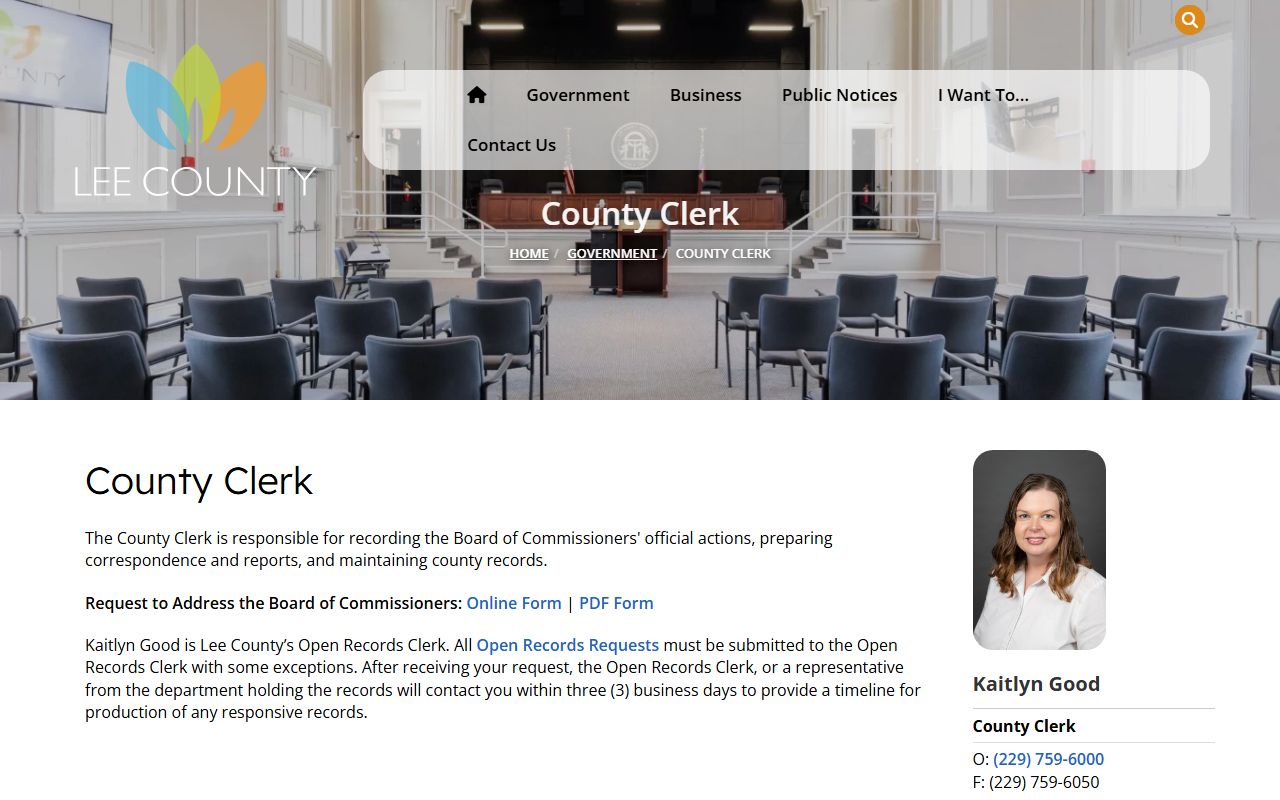
The screenshot supports the key distinction between county administrative records and court records kept by the Clerk of Superior Court.
Lee County County Clerk
Clerk: Kaitlyn Good
102 Starksville Avenue North
Leesburg, GA 31763
(229) 759-6000
kaitlyn.good@leecountyga.gov
Monday-Friday, 8:00 am-5:00 pm
County Clerk vs Court Clerk
Lee County has a split that can confuse record searches. The County Clerk is not the court clerk. The Clerk of Superior Court is Sara Clark and handles Superior Court records, deeds, liens, divorce decrees, criminal cases, civil cases, and warrants filed in Superior Court. The County Clerk is Kaitlyn Good and handles Board records and open-records coordination. A person searching Lee County court records should not send a case-copy request to the County Clerk unless the county's open-records process is being used to route the request.
The practical rule is simple: send court case, deed, lien, and divorce decree questions to the Lee County Clerk of Superior Court; send Board records and general county open-records requests to the County Clerk; send jail, booking, incident, accident, arrest, and police-report questions to the Sheriff's Office.
- County Clerk: Board actions, county records, correspondence, reports, and open-records coordination.
- Clerk of Superior Court: civil and criminal court files, divorce decrees, deeds, liens, warrants, and clerk certifications.
- Probate Court: marriage licenses, wills, death certificates, estates, guardianships, and vital-record certified copies.
- Sheriff's Office: arrest records, police reports, jail records, incident reports, accident reports, and Citizen Connect data.
Submit Open Records Requests
Lee County's open-records request page says Georgia's Open Records Act gives the public a right to inspect or receive public records unless a law or court order exempts them. The page asks requesters to be specific by including date ranges, subjects, record types, author, and similar locating details. County records requests go to the Open Records Clerk, with exceptions for department-held records.
- Identify the record and the likely custodian, such as County Clerk, Clerk of Superior Court, Probate Court, Sheriff's Office, or Georgia Department of Public Health.
- Use the online open-records form, the PDF request form, email, mail, or in-person delivery with a clear description of the records sought.
- Include date ranges, names, departments, document types, and the preferred way to inspect or receive copies.
- Review any cost notice before staff produces copies, media, or labor-intensive searches.
County Request Form Fields
The Lee County Open Records Act request PDF is one page and is designed for a direct written request. It includes requester contact information, a description of records requested for inspection, a requested availability date, and a fee acknowledgement area. These fields should be filled with enough detail for the County Clerk or receiving department to decide where the record lives and what exemptions or costs may apply.
| Field | Required | Notes |
|---|---|---|
| Date of request | Unspecified | Placed at the top of the county PDF form. |
| Name of requestor | Unspecified | Used for the official request and response. |
| Address, email, phone | Unspecified | Needed for notices, cost estimates, and delivery. |
| Records requested for inspection | Yes by function | Describe the exact records, date range, subject, office, author, and record type. |
| Fee acknowledgement | Conditional | Printed name and signature acknowledge administrative and copying costs. |
Lee County Request Costs
Lee County posts open-records costs on the county page and PDF. These charges apply to open-records processing, not necessarily to every court-certified copy issued by the Clerk of Superior Court or Probate Court. The County Clerk's office may tell a requester that a record belongs to another custodian, and that office may have its own copy or certification process.
| Item | Amount |
|---|---|
| Letter/legal copies | $0.10 per page |
| First 15 minutes of labor | No charge |
| Labor after 15 minutes | Lowest-paid qualified full-time employee hourly rate |
| CD-R or DVD-R media | $0.20 |
| Flash drive for video/audio | $3.00 |
| Envelope | $0.20 |
| Postage | Varies |
County Records Routing
Lee County's official routing page prevents many wrong-office requests. Court records do not all belong to the same place. Superior Court handles criminal and civil records, divorce decrees, deeds, and property liens. Probate Court handles marriage licenses, wills, and death certificates. The Sheriff's Office handles its own law-enforcement records. The Georgia Department of Public Health handles state vital records.
The U.S. Attorney Albany Division page appears in the county-clerk manifest set as a federal-office reference, but federal criminal records from Lee County are not county-clerk records.
That federal distinction helps keep Lee County County Clerk records separate from federal court, federal prosecutor, and U.S. Marshals records handled outside county government.
- Online open-records form for web submission to Lee County.
- Open Records Act request PDF for written requests and fee acknowledgement.
- Superior Court clerk page for court and land-record files.
- Probate Court page for marriage, wills, death certificates, estates, guardianships, and traffic fines.
County Clerk Limits
The County Clerk does not issue certified court case copies, does not manage the jail roster, and does not decide whether a sealed or restricted court file can be released. Those questions belong to the custodian named by the record type. If the request is broad, the County Clerk can still receive an open-records request and route it, but a specific request sent to the right office will usually be easier to process.
For Lee County court records, use the Clerk of Superior Court at the courthouse. For Probate Court matters, use Probate Court. For sheriff records, call the Sheriff's Office or use Citizen Connect. For general county administrative records, Board materials, and open-records coordination, Kaitlyn Good's County Clerk office is the correct local contact.
The County Clerk's location also helps separate record paths. Kaitlyn Good's office is in the T. Page Tharp Governmental Building at 102 Starksville Avenue North. The Clerk of Superior Court and Probate Court are at 100 Leslie Highway, and the Sheriff's Office is at 119 Pinewood Road. A request mailed to the wrong building can still be routed, but a request sent to the named custodian is clearer and easier to track.
Lee County's open-records request form asks for the date of request, requester name, address, email, phone, the records requested for inspection, and the date the requester wants the records available. The county page says requesters should be specific with date ranges, subjects, record types, authors, and similar details. A request for all court records is too broad for efficient routing. A request for a named Board action, a specific sheriff incident report, or a particular Superior Court divorce decree points staff toward the correct office.
Open-records costs are not a penalty. They are the county's way to recover copy, media, postage, search, retrieval, and redaction costs allowed by Georgia law. The first 15 minutes of labor are free, and later labor is based on the lowest-paid full-time employee with the necessary skill and training. If a request might be costly, ask for an estimate before copies are produced.