
Lee County Clerk Office
Lee County's Superior Court page identifies Sara Clark as Clerk of Superior Court. The Georgia Superior Court Clerks' Cooperative Authority lists her as Sara R. Clark, year elected 2009, county code 88, and the clerk for Superior Court. This office is the main local custodian for Superior Court civil and criminal files, divorce decrees, real estate records, liens, criminal warrants filed in Superior Court, notary appointments, jury support records, and several fee collections tied to court or property filings.
The GSCCCA Lee County clerk profile gives function contacts for criminal, civil, real estate, and bookkeeping work. That matters because a Lee County Clerk of Superior Court records request is more precise when it names the file type. A criminal case copy, a civil judgment, a deed, a fi fa, and a divorce decree may all involve the clerk, but they are not searched the same way.
The GSCCCA profile is the source shown here for Lee County Clerk of Superior Court office contacts.
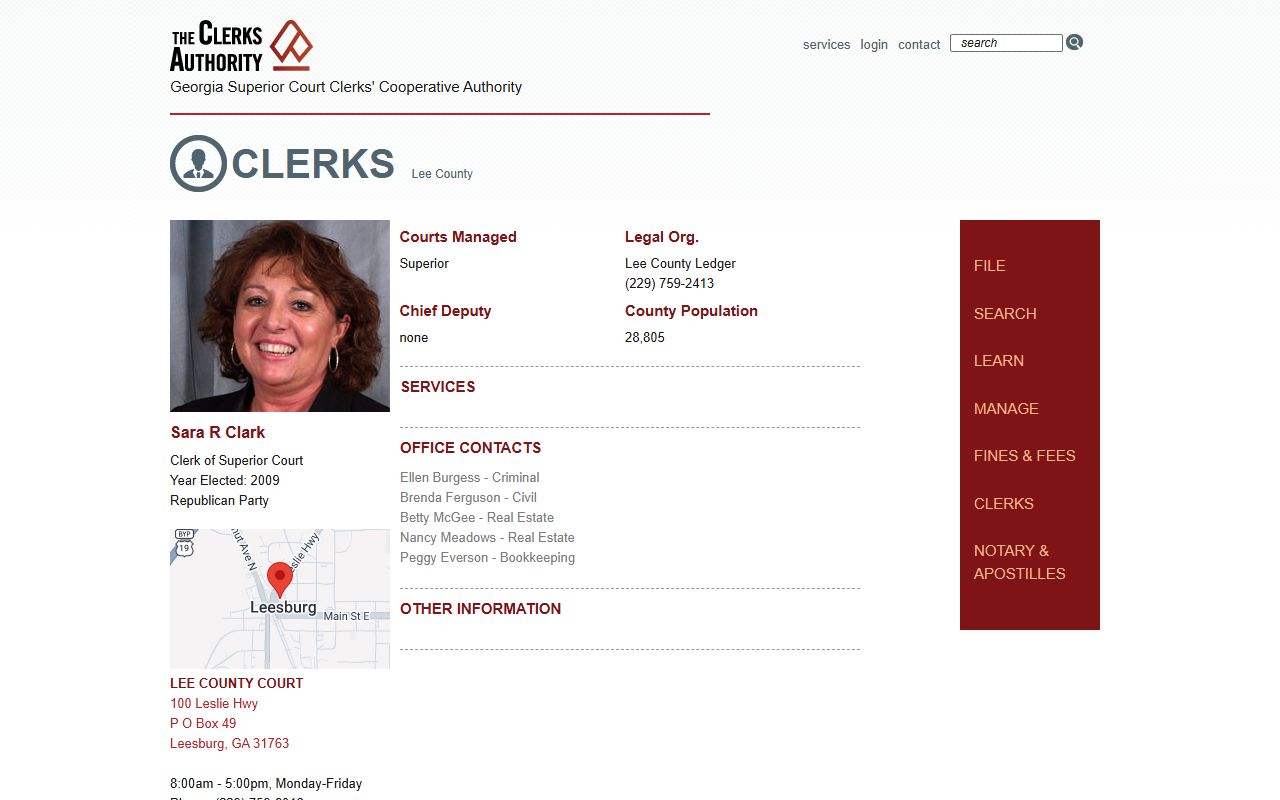
The state clerk profile is useful when a user needs the official county code, the legal organ, or a functional office contact before requesting Lee County Clerk records.
Lee County Clerk of Superior Court
Clerk: Sara Clark
100 Leslie Highway
Leesburg, GA 31763
(229) 759-6018
sara.clark@gsccca.org
Monday-Friday, 8:00 am-5:00 pm
Lee County Clerk Duties
The clerk page is unusually detailed about Lee County Clerk of Superior Court duties. The office maintains court records, files criminal cases, keeps criminal warrants, files civil cases, records divorces and annulments, handles adoptions, name changes, habeas corpus cases, suits for damages, garnishments, and repossessions, and helps the public with court records. The same office records warranty deeds, quitclaim deeds, security deeds, assignments, right-of-way deeds, easements, and property plats.
Several non-case functions also run through the clerk. The office records fi fas, military discharges, trade names, and UCCs; collects probation fines, child support payments, and property transfer taxes; issues notary appointments; assists with jury selection; and keeps election ballots for the statutory two-year period. These duties explain why the clerk is often the right starting point even when a request is not a simple lawsuit search.
- Criminal records: filed criminal cases, warrants kept in Superior Court, pleas, orders, sentencing, and dispositions when available in the court file.
- Civil records: divorces, adoptions, name changes, habeas cases, damages suits, garnishments, repossessions, and judgments.
- Real estate records: deeds, assignments, security deeds, plats, liens, UCC filings, and fi fas.
- Public service functions: notary appointments, jury assistance, payment collections, and public help with Lee County court records.
Request Certified Lee Records
A certified Lee County Clerk record is the copy to ask for when a court, agency, title company, school, lender, or other official reviewer needs proof that the document came from the clerk's file. Research did not locate a Lee County-posted Superior Court copy fee schedule, so requesters should confirm clerk copy and certification costs before mailing payment. Open-records copy costs are posted separately for county records, but those are not the same as every clerk certification fee.
- Identify the record type first: criminal case, civil case, divorce decree, deed, lien, fi fa, warrant, or other Superior Court filing.
- Gather names, approximate filing date, case number if known, document type, and whether the copy must be certified.
- Contact the Clerk of Superior Court by phone, mail, email, or in person to confirm availability, copy cost, and pickup or mailing options.
- If the request is routed as an open-records request instead, include enough detail for the Open Records Clerk to route it to the proper custodian.
Note: Adoption, juvenile, sealed, and restricted criminal-history records may not be available through a routine public counter request.
Lee County Request Fields
Lee County's open-records PDF is a useful fallback when a request is not handled through a clerk counter transaction. The county asks requesters to be specific, including dates, subjects, record types, and other details that help staff locate the file. Court records, divorce decrees, deeds, and property liens route to Superior Court under the county's routing page, while general county records route through County Clerk and Open Records Clerk Kaitlyn Good.
| Field | Required | Notes |
|---|---|---|
| Date of request | Unspecified | Shown at the top of the Lee County Open Records Act request form. |
| Name, address, email, phone | Unspecified | Contact details let the county respond and provide cost notices. |
| Records requested for inspection | Yes by function | Describe case type, parties, dates, document names, author, or other locating details. |
| Date records are requested | Unspecified | The requester may list a preferred date for availability. |
| Fee acknowledgement | Conditional | Name and signature acknowledge administrative and copying costs when charged. |
Lee County Clerk Fees
The research file found open-records costs and Magistrate Court fees, but it did not locate a Lee County official Superior Court copy and certification fee table. The careful rule is to publish the known county costs and tell users to confirm Superior Court certification fees with the clerk before relying on an amount. Georgia Superior Court clerk fees are tied to state law, including O.C.G.A. 15-6-77, but local confirmation is still the practical step before payment.
| Item | Amount |
|---|---|
| Lee County open-records letter/legal copies | $0.10 per page |
| Open-records labor | First 15 minutes free |
| Labor after first 15 minutes | Hourly rate of the lowest-paid qualified full-time employee |
| CD-R or DVD-R media | $0.20 |
| Flash drive for video/audio | $3.00 |
| Superior Court copies/certifications | Confirm with Clerk of Superior Court |
Clerk Access Channels
There is no single free Lee County Superior Court case-search field list published on the county page. The access chain is therefore practical: use statewide clerk resources for directory and real estate-related tools, use the Clerk of Superior Court for case files and certified copies, and use the county open-records route when a request needs formal routing. Magistrate civil files from 2023-present use a separate account-required Tyler portal, so they should not be confused with Superior Court case access.
The county page for the Lee County County Clerk documents the separate open-records clerk role.
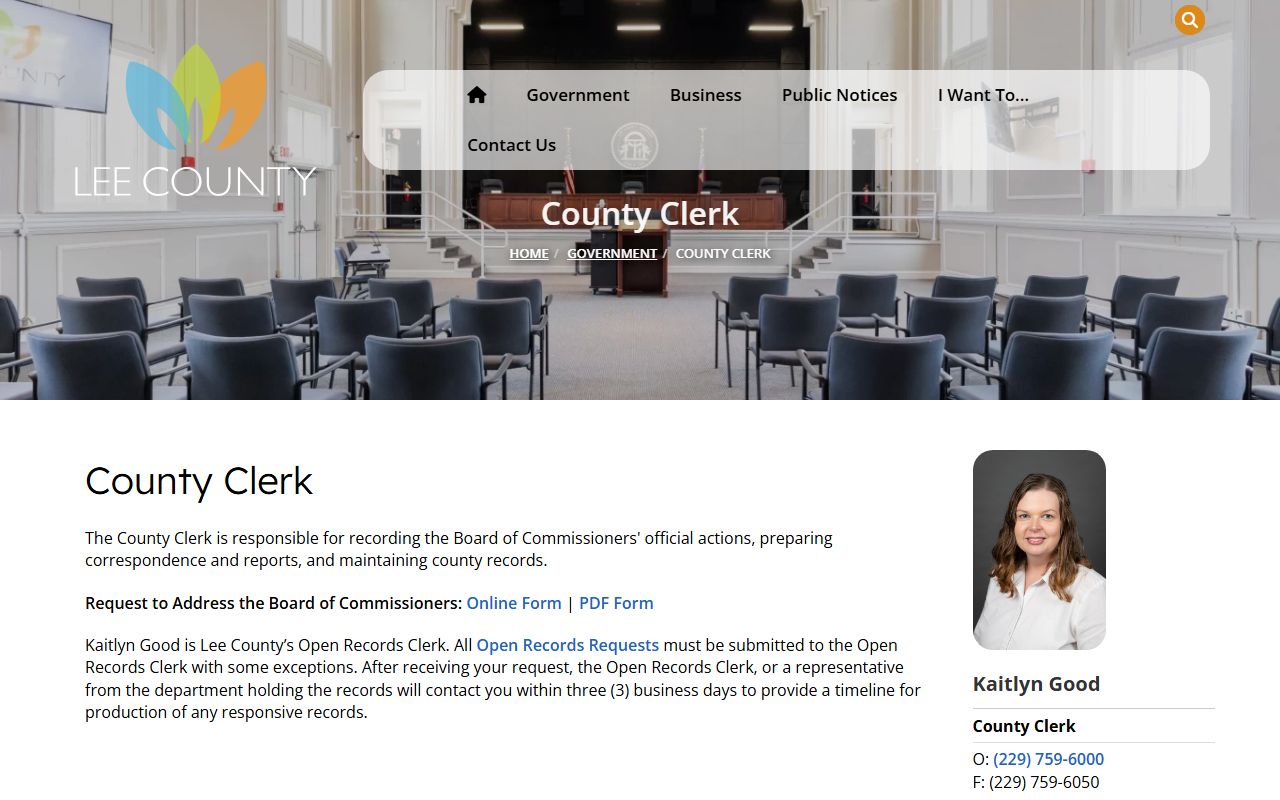
That separation is important: the Clerk of Superior Court keeps trial-court and land records, while the County Clerk handles Board records and county open-records coordination.
- Superior Court clerk page for clerk duties, address, hours, phone, fax, and email.
- GSCCCA Lee County profile for state clerk directory details and functional contacts.
- Lee County open-records routing for requests that need formal routing to a custodian.
- Online open-records form for county records requests when the web form is the chosen route.
Mail and Online Records
Mail for the Clerk of Superior Court goes to PO Box 49, Leesburg, Georgia 31763. In-person service is at the county courthouse on Leslie Highway. Phone, fax, and email access are listed by the county, and the GSCCCA profile supplies additional office-contact context. For Lee County Clerk records, mail requests should state whether the requester wants inspection, plain copies, certified copies, or a records search.
Electronic access depends on the record. The Georgia Courts e-access page routes users to provider websites and warns that provider account access may be required. Lee County Magistrate Court separately links public civil file access for 2023-present with account creation. That Magistrate portal does not replace the Clerk of Superior Court for felony, major civil, divorce, deed, lien, or Superior Court warrant records.
For criminal and civil case copies, the safest Lee County Clerk of Superior Court search path is to call the clerk, identify the case or party names, confirm whether the file is public, and ask how the office wants payment and delivery handled.
GSCCCA also separates Lee County office contacts by function: Ellen Burgess for criminal, Brenda Ferguson for civil, Betty McGee and Nancy Meadows for real estate, and Peggy Everson for bookkeeping. Those names should not be treated as separate custodians, but they are useful when a request needs to be routed inside the clerk's office. A deed copy request and a criminal case copy request should not be phrased the same way.
The clerk's election-related and jury-related duties also explain why some records at the office are not case files. The Superior Court page says the clerk assists in jury selection and keeps election ballots for the statutory two-year time limit. Those functions are part of the office, but a jury notice, ballot-retention question, UCC filing, and divorce decree each have different access rules. The more exact the request, the less likely it is to be delayed or sent to the County Clerk for routing.
Lee County's history can matter for older clerk records. The county seat moved from Starksville to Wooten Station in 1872, and the town became Leesburg in 1874. Older references may use Starksville, Wooten, or Leesburg, and the original Starksville courthouse burned in the nineteenth century. For historical court or land research, ask the clerk or a Georgia historical repository how older indexes survived before assuming a modern file exists at the courthouse.