
Lee County Criminal Court Records
Lee County criminal court records are primarily tied to Superior Court once felony or broader criminal case activity is filed with the court. The Clerk of Superior Court files criminal cases and maintains criminal warrants. Those files can include charging documents, warrants, bond orders, arraignment records, pleas, motions, orders, sentencing entries, probation orders, revocation activity, and final dispositions. The clerk is Sara Clark, and the court-record office is at 100 Leslie Highway, Leesburg, Georgia 31763, with phone (229) 759-6018.
Magistrate Court is also part of the criminal path, but it serves a different role. Lee County Magistrate Court issues arrest and search warrants, handles warrant application hearings, first appearances, bond hearings, preliminary hearings, extradition hearings, committal hearings, good behavior bonds, county ordinance violations, misdemeanor bad checks, criminal trespass, under-21 alcohol matters, shoplifting, and possession of marijuana less than one ounce. A Magistrate event can shape the case, but the full criminal court record and final Superior Court disposition should be confirmed through the court that owns the case.
The county's Southwestern Judicial Circuit page places Lee County in the circuit that handles felony prosecution and broader trial-court administration.
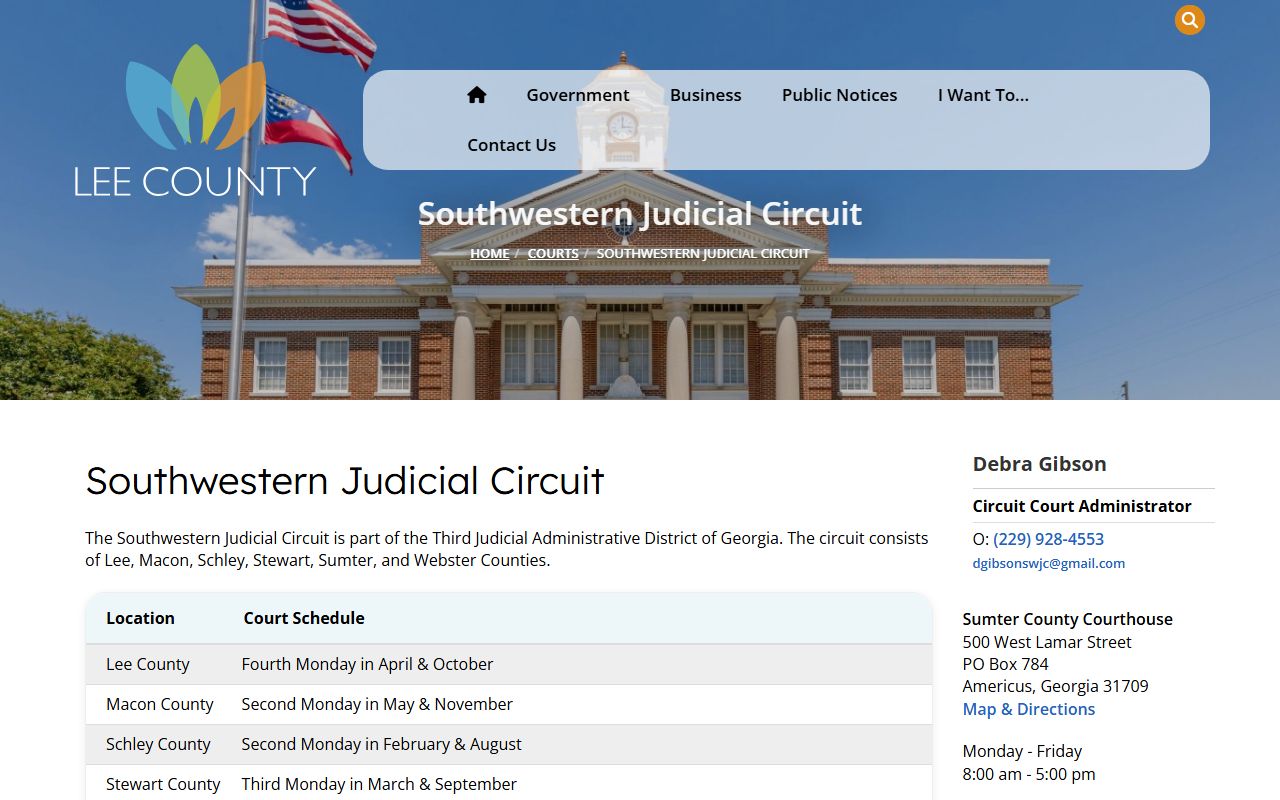
That circuit context matters because felony prosecution and defense resources for Lee County are organized at the multi-county circuit level.
Search Lee County Criminal Court Records
Lee County does not publish a single free Superior Court criminal case portal on the county website. The practical access chain is to identify the court, use any official portal that court links, then contact the Clerk of Superior Court when the record is not online, requires certification, or is older. For full criminal case files, start with the Clerk of Superior Court rather than Citizen Connect. Citizen Connect can show law-enforcement arrest, booking, incident, accident, and daily-report records, but those are not final court records and do not prove conviction.
- Use the case paperwork, arrest date, warrant papers, or notice to identify whether the matter is in Superior Court, Magistrate Court, Probate Court, or a municipal venue.
- For Superior Court criminal case records, contact the Clerk of Superior Court at 100 Leslie Highway or call (229) 759-6018.
- Ask for the docket, charging document, plea, disposition, sentence, or certified copy needed for the specific purpose.
- Use Sheriff Citizen Connect only for related arrest, booking, incident, accident, or daily-report facts, not as the final court case source.
- If the record holder is unclear, use Open Records Clerk Kaitlyn Good at (229) 759-6000 or kaitlyn.good@leecountyga.gov for routing.
The broad all-records access path is covered in the Lee County court records overview, while charge-focused arrest-to-court details belong in the Lee County arrest records and charges page.
Lee County Criminal Case Stages
A criminal case record grows as the case moves from allegation to outcome. At the earliest stage, law enforcement may create an arrest, incident, or booking record. The court record begins to matter when a warrant, accusation, indictment, complaint, bond order, arraignment, or other case filing reaches the court. The District Attorney's Office is relevant for felony and serious prosecutions, while defense counsel or the Public Defender may appear when a defendant is eligible for appointed counsel.
Case flow: Charges Filed › Arraignment › Pretrial / Motions › Plea or Trial › Disposition › Sentencing
| Stage | What Happens |
|---|---|
| Charges Filed | The State of Georgia, prosecutor, court, or warrant process identifies the criminal counts before the court. |
| Arraignment | The defendant is formally advised of charges and enters a plea such as guilty or not guilty. |
| Pretrial / Motions | The parties file requests, address evidence, set hearings, or resolve legal issues before trial. |
| Plea or Trial | The case is resolved by plea, trial verdict, dismissal, or other disposition. |
| Sentencing | The court enters punishment, probation, fines, restitution, jail, prison, or other conditions after conviction. |
What Lee County Criminal Records Show
A Lee County criminal court record is more complete than an arrest record because it can show how each charge changed and how the case ended. It may list the court, case number, defendant, prosecutor, defense counsel, charges, statute references, count numbers, misdemeanor or felony classification, warrant number, bond entries, arraignment, pleas, motions, orders, hearing dates, verdict, disposition, sentence, probation, revocation, fines, restitution, and appeal activity. Some details can be redacted, especially victim information, minor identifiers, financial information, sealed content, or restricted criminal-history material.
| Field | What It Shows |
|---|---|
| Case Number | The court's tracking number for the criminal case or related docket. |
| Defendant | The person charged, subject to redaction of private identifiers. |
| Charges | Counts, offense descriptions, warrant information, statute references, and felony or misdemeanor class when shown. |
| Plea | The defendant's formal answer to a charge, such as guilty, not guilty, or another accepted plea entry. |
| Docket Activity | Arraignment, motions, hearings, continuances, orders, trial settings, and clerk entries. |
| Disposition | The final outcome of each charge, including conviction, dismissal, acquittal, or other result. |
| Sentence | Probation, confinement, fines, restitution, conditions, revocation, or other court-ordered punishment. |
Lee County Charges vs Convictions
A charge is an allegation brought into the court process. A conviction is a final legal outcome after a guilty plea, verdict, or accepted adjudication that results in guilt. A criminal court record may show charges that were amended, reduced, dismissed, dead docketed, or otherwise resolved without conviction. This is why a booking or charge list should not be treated as the final criminal case result.
| Charge | Conviction | |
|---|---|---|
| Timing | Appears early in the case or after a warrant, accusation, indictment, or complaint. | Appears after plea, verdict, or final court decision. |
| Meaning | An allegation that the State must prove or resolve. | A finding or admitted outcome that carries legal consequences. |
| Record Effect | May later be dismissed, amended, reduced, or restricted. | May affect sentence, probation, fines, custody, and criminal history. |
Note: Citizen Connect arrest facts can help identify a case, but the court disposition controls the final outcome.
Lee County Criminal Case Offices
The Southwestern Judicial Circuit District Attorney is Lewis R. Lamb. The District Attorney's Office prosecutes criminal matters for the circuit that includes Lee County. Official sources list the office in Americus, with phone (229) 924-5411 and fax (229) 928-4271. The Prosecuting Attorneys' Council profile lists the district attorney contact details for Lewis Lamb.
Defense representation may involve private counsel or the Public Defender if the defendant qualifies. The Georgia Public Defender Council lists the Southwestern Circuit Public Defender as David Winheim, serving Lee, Macon, Schley, Stewart, Sumter, and Webster Counties. The office is at 510 West Lamar Street, 2nd Floor, Americus, Georgia 31709, with phone 229-928-4610 and fax 229-928-4594. These offices may appear in the criminal court record, but copy requests still go to the clerk that keeps the file.
The Southwestern Judicial Circuit District Attorney page is a local government source for the prosecuting office.
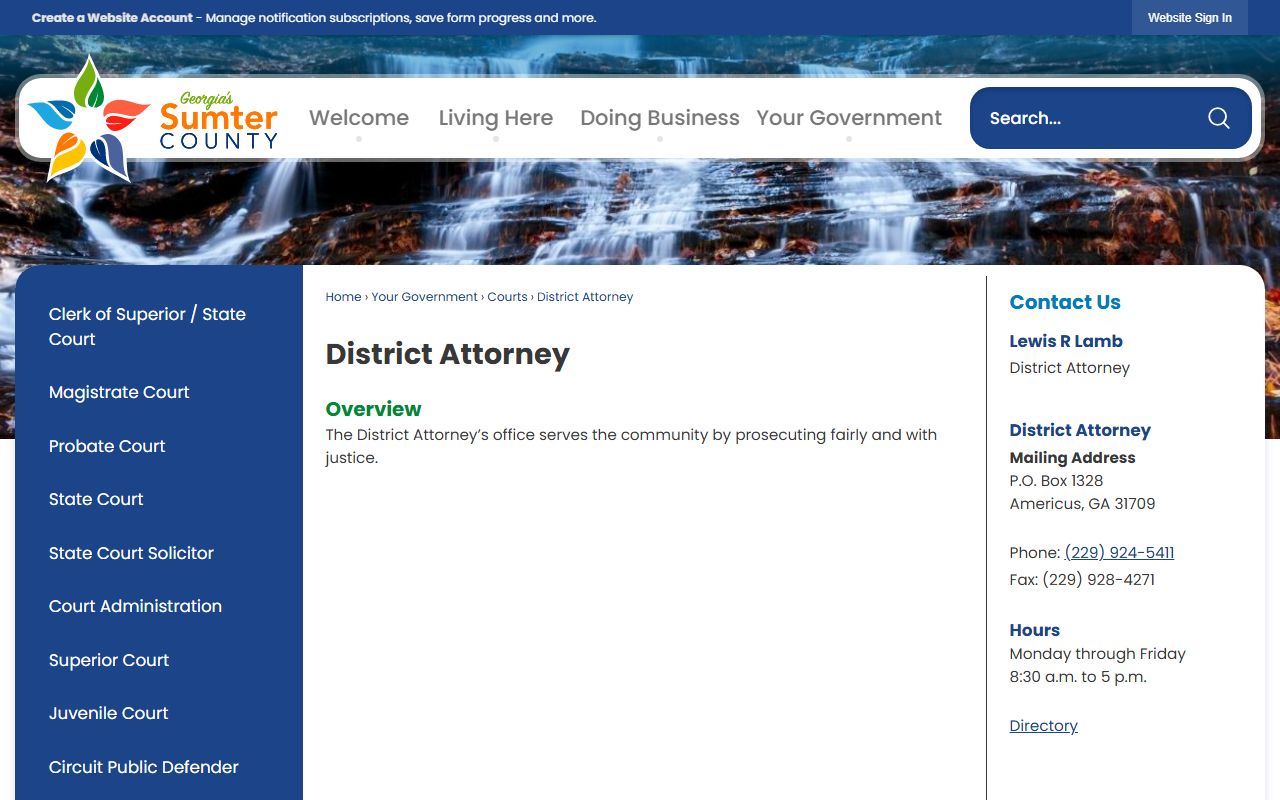
That office is relevant to filed charges, plea negotiations, dismissals, and record-restriction questions that GBI says may require prosecutor contact.
Lee County Arrest Records Context
Law-enforcement records are useful when a criminal court record search starts with an arrest date, agency name, or booking entry. The Lee County Sheriff's Office uses Citizen Connect for bookings, missing persons, daily reports, incident reports, arrest search, accident reports, maps, patrol requests, personnel feedback, and inmate confinements. The Sheriff's Office is at 119 Pinewood Road, PO Box 610, Leesburg, Georgia 31763, with phone (229) 759-3334. Citizen Connect's footer lists non-emergency (229) 759-6034.
Use Sheriff records only for the law-enforcement side of the matter. An arrest search can show arrest facts and alleged charges, but it may not show plea, sentence, or final disposition. For current custody, use the jail or inmate channel. For active warrant questions, use the issuing court or Sheriff's Office. For the full criminal case file, use the court record and clerk request path.
Sealed vs Expunged Records
Georgia's practical term for many criminal-history matters is record restriction, not expungement. A restricted or expunged criminal-history record may be limited from non-criminal-justice access, while criminal-justice agencies may still retain access. A sealed court record is different because it generally depends on a law or court order limiting public court-file access. A public docket may show less detail when a case has restricted or sealed material.
| Sealed Court Record | Restricted or Expunged Criminal History | |
|---|---|---|
| Source | Court order or law controlling public access to court-file material. | Georgia criminal-history restriction process under O.C.G.A. 35-3-37. |
| Effect | Public users may not view all docket or document details. | Eligible arrest or charge history may be limited for non-criminal-justice purposes. |
| Contact | The court or clerk that keeps the file. | For many post-July 1, 2013 arrests, GBI says contact the prosecutor. |
Lee County Criminal Record Access
Public access to criminal court records is subject to Georgia public-record rules and court confidentiality limits. The Georgia Open Records Act, O.C.G.A. 50-18-70 et seq., gives a broad public-record right unless a law or court order exempts the record. O.C.G.A. 50-18-71 allows lawful search, retrieval, copy, redaction, and supervision charges. Lee County gives the first 15 minutes of labor at no charge, then may charge the hourly rate of the lowest-paid full-time employee with the needed skill or training.
Open-records requests should be specific. Lee County asks for date ranges, subjects, record types, author names, and other details. Open Records Clerk Kaitlyn Good is the county fallback contact at 102 Starksville Avenue North, Leesburg, Georgia 31763, (229) 759-6000, kaitlyn.good@leecountyga.gov. But the county routing table sends criminal and civil records to Superior Court and sheriff records, arrest records, and police reports to the Sheriff's Office, so the fallback should not replace the record-holding office.
Georgia Criminal Record Restriction
A person seeking restriction of a Lee County criminal-history record should separate the arresting agency record, the prosecutor's charging decision, the court case file, and the statewide GCIC criminal-history record. For arrests after July 1, 2013, the GBI criminal-history restrictions page says there is no application process and the person must contact the prosecutor. For arrests before that date, GBI says application is made at the arresting agency.
The GBI restriction source is official statewide guidance for Georgia criminal-history access.
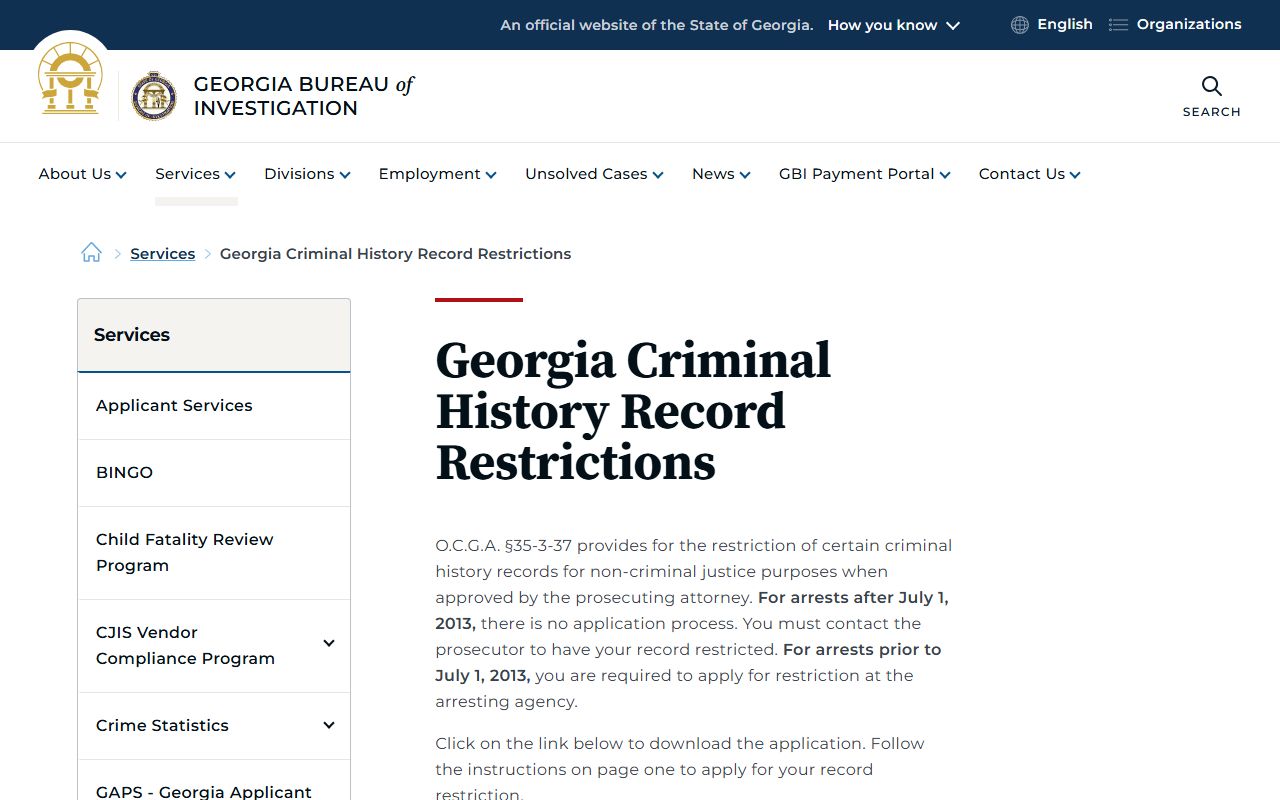
That process affects criminal-history visibility, while court-file sealing can still require separate court action or clerk handling.
The Southwestern Circuit Public Defender can be relevant for eligible defendants, but restriction or sealing questions are case-specific and should be confirmed with the proper court, prosecutor, or counsel.
Lee County Accountability Court
The Council of Accountability Court Judges directory lists the Southwestern Judicial Circuit Accountability Court, with a March 2013 start date, Judge W. James Sizemore, Jr., program coordinator Randi Duncan, phone (229) 815-5600, and email r.duncanswjc@gmail.com. The research did not locate a separate Lee County-only drug court, mental health court, veterans court, or family treatment court page. The accurate local term is the circuit accountability court.
Accountability court entries may appear in criminal court records when an eligible defendant is routed into structured court supervision, treatment, testing, compliance reviews, or sanctions. Eligibility depends on case facts, charge type, history, prosecutor and judge approval, treatment need, and program capacity. These entries are still part of a court case and should be read with the full docket and disposition.
The Prosecuting Attorneys' Council district attorney profile is another official source for Lee County criminal prosecution context.

Prosecutor information helps connect charge decisions, dismissals, pleas, and record-restriction routing to the correct Southwestern Judicial Circuit office.